

Welcome to the PyTorch Foundation monthly newsletter!
Last month, I attended WAIC in Shanghai, one of the world’s largest AI events. Everywhere I went, one theme came up again and again: open-source software is accelerating AI progress.
The reason is becoming clearer. The AI stack is not converging on a single model, hardware architecture, or system. It is becoming more diverse. That makes coordination across frameworks, compilers, kernels, serving systems, distributed infrastructure, and hardware more important, not less.
In recent weeks, the PyTorch ecosystem has shown what that coordination looks like in practice. Our six hosted projects shared updates from the past quarter, while contributors across the broader ecosystem continued pushing the stack forward. vLLM delivered day-zero support for major new models, including Kimi K3 running on NVIDIA GB300 systems; PyTorch-Triton made GPU compilers easier to extend without maintaining separate forks; Helion expanded to Google TPUs; contributors improved FP8 training on AMD GPUs; and PyTorch 2.13 expanded support across Apple silicon, ROCm, Arm, and Intel XPU.
These efforts come from different projects and companies, but together they are building a shared technology stack that can evolve across vendors while reducing fragmentation.
In a few weeks, we will return to Shanghai for the first PyTorch Conference China, followed by PyTorch Conference North America in San Jose this October. I look forward to continuing these conversations with the people building and operating AI systems across every layer of the stack.
Whether you contribute code, run AI in production, organize local meetups, or are just getting started, thank you for building this ecosystem with us.
Cheers,
Mark Collier
Executive Director, PyTorch Foundation

Announcements
 PyTorch Conference North America Schedule Is Live
The full schedule, including keynotes, for PyTorch Conference North America (San Jose, October 20 – 21) is now live! Expect keynotes from Meta, Red Hat, NVIDIA and more with sessions spanning training and inference, compiler innovations, responsible AI, and the wider PyTorch ecosystem. Check out the session highlights and how to register here 👉 PyTorch Conference North America Schedule Is Live
 PyTorch Foundation Flare Pin Community Design Contest
The PyTorch Foundation invited the community to design the 2026 flare pin for PyTorch Conference North America 2026! The winning designer will receive a complimentary conference ticket to PyTorch Conference North America in San Jose, and the design will be produced as a one-inch enamel pin. Stay tuned to learn which design will win!🔥
Upcoming Events
 KubeCon + CloudNativeCon + OpenInfra Summit + PyTorch Conference China 2026, Shanghai, September 7-9
Just three weeks to go before the first PyTorch Conference China 2026 starts! View the complete schedule here and register here. Sessions will cover everything from how AI Agents are rewriting the OpenStack/K8s playbook to The State of the PyTorch Ecosystem in 2026: Global Trends and China’s Rising Role. Register here 👉 PyTorch Conference China 2026
Recent Events
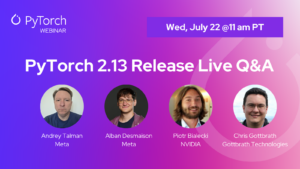 PyTorch 2.13 Release Live Q&A, Virtual, July 22
In this release webinar, PyTorch maintainers and contributors provided a brief overview of the PyTorch 2.13 release, talking through highlights such as FlexAttention now running on Apple Silicon and answering questions live from the community. 👉 Watch the complete webinar recording
 World Artificial Intelligence Conference (WAIC) 2026, Shanghai, July 17-20
The event featured conferences and forums, exhibitions, competitions and awards, application experiences, innovation and incubation programs, talent and recruitment activities.
 AMD AI DevMaster Hackathon, Virtual, July 9- August 6
The virtual AMD AI DevMaster Hackathon invited developers, researchers, students, AI practitioners, and open source contributors to build applications across three tracks: Multimodal AI for content creation tools, Agentic AI for private AI agents and local deployment, and Physical AI for robotics simulation and application design.
 AgenticAI Summit 2026, Berkeley, August 1-2
The Agentic AI 2026 Summit is designed to be the largest and most comprehensive event dedicated to Agentic AI – bringing together leaders across the full stack, from foundation models and agent frameworks to evaluation, infrastructure, and real-world deployment. PyTorch Foundation had a sponsor booth and led a workshop on “The Open Agentic Stack: Building the Future of AI Systems with Open Source, Open Standards and Composability” on August 1st at 3.50pm.
In the News
“The PyTorch Foundation’s April 2025 expansion into a six-project open-source hub signals a deliberate move to govern the full AI lifecycle under a single vendor-neutral umbrella. This consolidation arrives as the AI platforms market approaches $181.3B in 2026, with a base forecast of $181.3B rising to $496.9B by 2030 at a 28.7% CAGR. For enterprises working through reliability, privacy, and infrastructure complexity, the Foundation’s portfolio now maps directly to their most pressing deployment challenges.”
Latest Blogs
 Driving the Future of Open Source AI: An Update from PyTorch Foundation Projects
A progress report on the PyTorch Foundation’s evolution into a multi-project foundation, with updates across the hosted projects that now sit under its umbrella.
 Fast, On Device Agentic AI with Muse Glimmer on ExecuTorch
Last week, Meta introduced Muse Glimmer, an open-weight, 30-billion-parameter model distilled from Meta’s Muse Spark for on-device agentic workflows. Alongside, ExecuTorch is adding end-to-end support for running Muse Glimmer on NVIDIA GPUs and Macs with Apple silicon.
 FP8 Training on AMD GPUs with TorchTitan and TorchAO: Upstreaming Performance Improvements
AMD has upstreamed FP8 training optimizations for AMD Instinct GPUs into PyTorch’s TorchAO and TorchTitan libraries, enabling out-of-the-box support, correct FNUZ numerics auto-detection, and native grouped GEMM for Mixture-of-Experts (MoE) models.
 PyTorch by the Sea: The inaugural Santa Cruz PyTorch Meetup
The Santa Cruz PyTorch Meetup brought together 45 local engineers, students, and leaders for GPU/CUDA talks and lightning presentations on chemistry, plant health, and autonomous driving – demonstrating how easy and impactful it is to launch a low-key, welcoming PyTorch community in your own area.
 FBTriton Infra: Upstream Ingestion, Hierarchical Validation, Ideals vs Realities
Meta’s Triton team explains how their FBTriton infrastructure ingests upstream changes and validates them hierarchically, and where the practical realities diverge from the ideal – enabling custom GPU compiler work like TLX and autoWS.
 Helion on TPU: Towards Hardware Heterogeneous Kernel Authoring
Helion, PyTorch’s high-level DSL for performance-portable ML kernels, now targets Google TPUs through a partnership with Google – a step toward authoring kernels that run across heterogeneous hardware.
 Triton Plugin Extensions: Enabling TLX and Custom Compiler Passes Out of the Box
The PyTorch-Triton 3.7 release introduces a Triton Plugin Extensions system, a framework for dynamically loading TLX and custom compiler passes without patching Triton itself.
PyTorch Foundation-hosted Projects Updates

Core PyTorch development momentum remains strong with Q2 commits reaching 4,415. The 2.13 release brought major performance and platform upgrades – including FlexAttention on Apple Silicon, memory savings via nn.LinearCrossEntropyLoss, and Python 3.15 support – while expanding on-device LLM capabilities through ExecuTorch and a Hugging Face partnership.

- The Kimi K3 release is one of the most significant open-weight model launches of the year, and vLLM delivered Day-0 Support at Launch. At 2.8 trillion parameters with a 1M-token context window and native vision, Kimi K3 is among the largest and most capable open models ever shipped. On 16 NVIDIA GB300 NVL72 GPUs, vLLM serves it at 118 tokens per second per user out of the box, reaching 464 tok/swith DSpark speculative decoding. Getting there required upstream work across three of Kimi K3’s most novel architectural ideas: Kimi Delta Attention, a hybrid linear-plus-full-attention stack that keeps 1M-token context affordable and required a redesign of prefix caching over recurrent state; Attention Residuals, which replace standard residual connections with learned depth-wise mixing across layers; and Stable LatentMoE, which scales sparsity to 16-of-896 experts through quantile-balanced routing. The hybrid-cache infrastructure built for Kimi K3 now benefits every hybrid linear-attention model in vLLM.
- Work across the Q3 2026 roadmap is landing steadily. On agentic serving, vLLM shipped two new KDA cache retention policies: interval-based checkpointing with automatic prompt-boundary retention, and Marconi-style selective retention that caches on the second hit. On speculative decoding, the DSpark integration for Kimi K3 landed alongside upstream Speculators work and in-flight confidence-based scheduling to prune weak drafts before verification. On large-scale serving, prefill/decode disaggregation was extended to hybrid SSM-attention models via NIXL and TEP prefill gained sequence parallelism with custom communication kernels 1.7–4.5× faster than NCCL at small-to-medium message sizes.
- The vLLM community is converging in San Francisco August 24–26 for the first-ever vLLM Conference at Ray Summit. The two-day program brings together speakers from NVIDIA, AMD, Google TPU, Meta, Red Hat, DigitalOcean, and Hugging Face across sessions on the vLLM roadmap, agentic serving, and production-scale inference. Sign up here.

DeepSpeed continues to maintain rapid development with bi-weekly software releases, virtual office hours, and core updates including direct Torch.xpu integration for Intel GPUs, AMD SDMA optimizations, and automatic sequence parallelism.
 Ray is advancing production hardening for large-scale AI workloads by optimizing actor scheduling, topology-aware placement, hardware support for systems like GB300s, and post-training/inference pipelines through deep integrations with vLLM and SkyRL. If you want to connect with the team and community in person, Ray Summit is set for August 24-26 in San Francisco.

Over the past few months, Helion has achieved major performance portability milestones with CuTeDSL and Pallas backends, enabling its attention kernel to outperform cuDNN and FlashAttention-4 on NVIDIA Blackwell GPUs and Tokamax on Google TPUs. Helion kernels have also landed in HuggingFace Kernels Hub.

Recent updates from Safetensors worth highlighting include the introduction of Global Interpreter Lock (GIL)-Free Serialization, Python 3.14/3.14t CI support, Metal Performance Shaders fast-load paths for reduced latency on Apple hardware, and expanded precision dtypes.