

Welcome to the April edition of the PyTorch Foundation Newsletter. Inside: highlights from PyTorch Conference Europe 2026, Helion and Safetensors joining as foundation-hosted projects, ExecuTorch becoming part of PyTorch Core, the PyTorch 2.11 release and webinar replay, upcoming community events, and recent technical blogs from across the ecosystem.
Announcements
 PyTorch Conference Europe 2026
The first-ever PyTorch Conference Europe brought 600+ researchers, developers, practitioners, and academics to Paris (April 7–8) for two days of keynotes, technical sessions, poster presentations, and community events. We celebrated major moments for our ecosystem, with announcements spanning hosted projects, PyTorch Core, inference, kernel authoring, and production infrastructure. Read the recap >> & Watch the Sessions >>
 PyTorch Foundation Welcomes Helion as a Foundation-Hosted Project
Contributed by Meta, Helion joins PyTorch Foundation as a foundation-hosted project to standardize open, portable, and accessible AI kernel authoring. Helion is a Python-embedded DSL for machine learning kernels designed to simplify kernel development, reduce manual coding effort through autotuning, and improve hardware performance portability across backends. Learn more >>
 Safetensors Joins PyTorch Foundation
Contributed by Hugging Face, Safetensors joins PyTorch Foundation as a foundation-hosted project to support secure model distribution and trusted production workflows. Safetensors prevents arbitrary code execution risks associated with legacy pickle-based formats while supporting fast loading across multi-GPU and multi-node deployments. Read more >>
 ExecuTorch Becomes a Part of PyTorch Core
ExecuTorch is now part of PyTorch Core, extending PyTorch functionality for efficient AI inference on edge and on-device environments, from desktop and laptop systems to mobile phones and embedded devices. The transition brings vendor-neutral governance and transparent open source structures to a project that continues to grow across hardware, tooling, and deployment workflows. Read more >>
 PyTorch 2.11 Release and Live Q&A Replay
PyTorch 2.11 adds differentiable collectives for distributed training, a FlashAttention-4 backend for FlexAttention on Hopper and Blackwell GPUs, expanded MPS operator support for Apple Silicon, RNN/LSTM GPU export support, and XPU Graph. Watch Andrey Talman and Nikita Shulga walk through the release and answer community questions in the webinar replay. Watch the replay >>
 PyTorch Foundation in the News
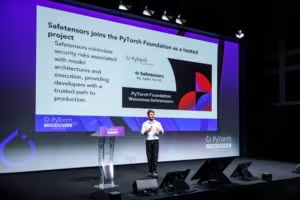
PyTorch Conference Europe announcements were featured in ComputerWeekly, Techstrong.ai, ITdaily, diginomica, HPCwire, It’s FOSS, ITBrief, and San Jose Today. In its event coverage, diginomica wrote that Helion and Safetensors mark the “difference between an open AI ecosystem that actually works in production and one that only works in the lab.” Read diginomica’s analysis >>
Upcoming Events
 OpenEnv AI Hackathon Finale
Introducing India’s first OpenEnv AI Hackathon, hosted by Meta in collaboration with Hugging Face and PyTorch. This initiative brings together developers across the country to build what powers the next generation of AI, not just use it. Participants build reinforcement learning environments using OpenEnv, Meta’s open-source RL framework, contributing directly to how intelligent agents are trained. The finale takes place April 25–26 as a 48-hour in-person hackathon in Bangalore, with a $30,000 prize pool and learning resources for developers new to RL.
 2026 PyTorch Docathon
The 2026 PyTorch Docathon will take place May 5–19. This hackathon-style event invites the community to improve documentation, lower barriers to entry for new contributors, and deliver practical usability gains across the project. RSVP here >>
 Open Source Summit North America
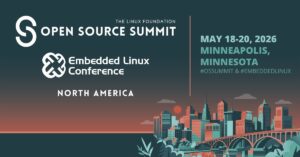
Open Source Summit is the premier event for open source developers and contributors. It’s where maintainers, technologists, and community leaders come together to share knowledge, collaborate on solutions, and push open source projects forward. Connect with the people shaping open source, learn from maintainers and community leaders, discover emerging technologies and practical solutions, collaborate on ideas and code, and grow your skills, your network, and your career. Learn more >>
 KubeCon + CloudNativeCon + OpenInfra Summit + PyTorch Conference China 2026
Registration and the Call for Proposals are open for the co-located event taking place September 8–9 in Shanghai. The event brings together cloud native infrastructure, open infrastructure, and open source AI communities in one venue. CFP submissions are due by Sunday, May 3 at 11:59 PM China Standard Time (UTC+08:00). Submit to speak >> Learn more >>
 PyTorch Conference North America 2026
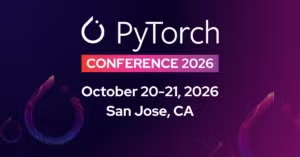
Join the PyTorch community in San Jose, California on October 20–21 for two days of technical talks, ecosystem collaboration, and open source AI engineering. The Call for Proposals is open for tracks including Kernel Engineering, Training, and Responsible AI, and session submissions close at 11:59 PM PDT on Sunday, June 7. Submit to speak >> Register now >>
Latest Blogs
 Meta: Optimizing Effective Training Time for Meta’s Internal Recommendation and Ranking Workloads
This post introduces Effective Training Time, or ETT%, as a metric for measuring how much end-to-end wall time is spent on productive training. It details work on trainer initialization, PT2 compilation, checkpoint management, shutdown optimization, and failure reduction, culminating in an increase to more than 90% ETT for offline training. Read more >>
 Meta, Hugging Face: Faster Diffusion on Blackwell: MXFP8 and NVFP4 with Diffusers and TorchAO
Learn how selective quantization and CUDA Graphs deliver reproducible end-to-end diffusion inference speedups on NVIDIA B200 GPUs, with up to 1.26x gains using MXFP8 and 1.68x gains using NVFP4. Read more >>
 Meta: Monarch: An API to Your Supercomputer
Monarch introduces a distributed programming framework that makes clusters programmable through simple Python APIs. The design targets agentic development workflows and combines a single-controller model with RDMA-powered file systems and distributed SQL telemetry. Read more >>
 Meta: SOTA Normalization Performance with torch.compile
This post evaluates LayerNorm and RMSNorm on H100 and B200, introduces MixOrderReduction, and shows how torch.compile can reach near state-of-the-art results with large speedups over eager mode. Read more >>
 Meta: Generating State-of-the-Art GEMMs with TorchInductor’s CuteDSL Backend
TorchInductor’s new CuteDSL backend adds an autotuning path for GEMM generation, delivering strong MXFP8 performance and significant gains for inference workloads on Blackwell hardware. Read more >>
 Meta: Flight Recorder: A New Lens for Understanding NCCL Watchdog Timeouts
Flight Recorder introduces a diagnostic ring buffer that captures collective metadata and call stacks, helping engineers identify CPU-side divergence and GPU hangs in distributed training jobs. Read more >>
Subscribe to the PyTorch Newsletter
Get updates directly to your inbox: https://pytorch.org/newsletter/
Get updates directly to your inbox: https://pytorch.org/newsletter/