

Welcome to the September PyTorch Foundation Newsletter!
We just wrapped up an incredible week in Shanghai for the first ever PyTorch Conference China, bringing together the open source, cloud-native, and AI ecosystems under one roof. The momentum across the region is inspiring, underscored by welcoming Alibaba Cloud and Cambricon as Platinum members, along with Ant Group as a Gold member. Representatives from the three new member companies and Huawei delivered keynotes on advancing the open source AI stack, covering hardware, models, and infrastructure.These commitments reinforce our shared belief in neutral, open governance and ensure that as the underlying infrastructure stack scales – spanning core PyTorch, vLLM, DeepSpeed, and Ray – it remains open, performant, and reliable for everyone.
That global energy sets the stage for what’s next as we head straight toward PyTorch Conference North America in San Jose this October. We are gearing up for deep technical tracks on hardware acceleration, agentic AI, and production ML systems that highlight how our community is turning research into real-world impact.
As a subscriber of our newsletter, I am offering you a 20% off discount code.
Enter Code: FRIEND
When you register at: https://hubs.la/Q04xDGK10
I encourage you to share this discount code with friends and colleagues you think should be at the event. The more people show up and collaborate, the stronger the open source AI community becomes.
Cheers,
Mark Collier
Executive Director, PyTorch Foundation

Announcements
 Alibaba Cloud, Ant Group, Cambricon and Huawei Come Together in Shanghai
Alibaba Cloud and Cambricon joined the PyTorch Foundation as Platinum members, and Ant Group joined as a Gold member. Together they strengthen the PyTorch Foundation’s open, vendor-neutral ecosystem by uniting alongside long-standing members to drive collaboration across hardware, models, and infrastructure.
 Cambricon Joins the PyTorch Foundation as a Platinum Member
Cambricon, founded in 2016 as an early pioneer in AI chips, has joined the PyTorch Foundation as a Platinum member to advance AI chip and software development within the ecosystem.
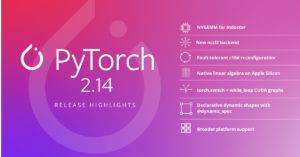 PyTorch 2.14 Release
PyTorch 2.14 is here, bringing CuTeDSL-generated CUTLASS kernels to Inductor, a new nccl2 backend for PyTorch Distributed, and expanded ROCm, Intel XPU, and NVIDIA platform support. Learn more at our upcoming PyTorch 2.14 Release Live Q&A.
 PyTorch Ecosystem Landscape Welcomes 10 New Projects
The PyTorch Ecosystem Working Group welcomed 10 new projects to the PyTorch Ecosystem Landscape – Perforated, AReaL, TorchJD, RLinf, Miles, SMG, FiftyOne, TokenSpeed, VisualTorch, and TorchSurv.
Upcoming Events
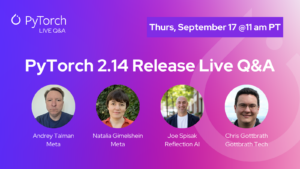 PyTorch 2.14 Release Live Q&A, Virtual, September 17, 2026
Bring your questions about PyTorch 2.14 to a live Q&A with maintainers from Meta and Reflection AI, moderated by Chris Gottbrath.
 London PyTorch Meetup, London, UK, September 16, 2026
An evening of PyTorch talks, food, drinks, and networking with the PyTorch Meetup London community, including talks on scaling model training with TorchTitan.
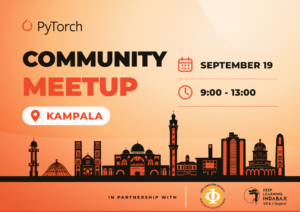 PyTorch Community Meetup Kampala, Kampala, Uganda, September 19, 2026
A gathering of students, researchers, developers, and open source contributors across Uganda and East Africa to learn, share, and connect around PyTorch and modern AI.
PyTorch Meetups Madrid (Spain), Madrid, Spain, October 14, 2026
The official launch of the PyTorch Meetups Madrid community, bringing together local talent working across production ML, research, and early Machine Learning journeys.
 PyTorch Conference North America 2026, San Jose, California, October 20-21, 2026
PyTorch Conference North America gathers top-tier AI pioneers, researchers, and developers to explore the future of open source AI and the impact of PyTorch Foundation projects including PyTorch, vLLM, DeepSpeed, Ray, Helion, and Safetensors.
 NVIDIA GTC Berlin, Germany, Berlin, Germany, October 20-22, 2026
An AI infrastructure conference featuring a keynote from NVIDIA CEO Jensen Huang and sessions spanning the AI stack, from hardware to physical AI.
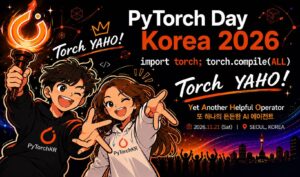 PyTorch Day Korea 2026, Seoul, South Korea, November 21, 2026
The first large-scale offline conference hosted by the PyTorch Korea User Group. This conference offers a collaborative space to share hands-on insights, solve real-world challenges, and drive open-source AI innovation together.
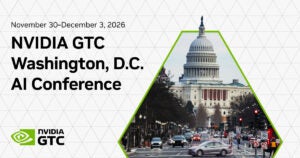 NVIDIA GTC Washington, D.C., Washington, D.C, November 30 – December 3, 2026
Government leaders, policymakers, scientists, and industry partners gather to explore how AI is accelerating American economic growth and scientific discovery, featuring a keynote from NVIDIA CEO Jensen Huang.
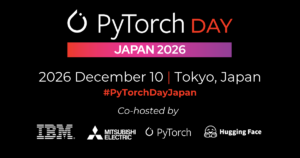 PyTorch Day Japan 2026, Tokyo, Japan, December 10, 2026
Hosted by the PyTorch Foundation, Hugging Face, IBM, and Mitsubishi Electric, this community-driven event is dedicated to open source AI and the impact of PyTorch Foundation projects.
Recent Events
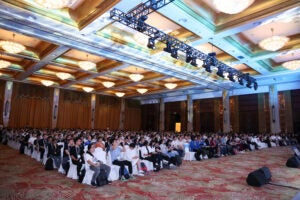 KubeCon + CloudNativeCon + OpenInfra Summit + PyTorch Conference China 2026, Shanghai, China, September 7-9, 2026
The first PyTorch Conference China convened the OpenInfra, cloud native, and AI communities in Shanghai, bringing adopters, technologists, and community members together across Kubernetes, OpenStack, and PyTorch. Framed by the vision of “Open Source for the AI Era,” PyTorch Conference China 2026 brought the global ecosystem together in Shanghai to advance an open, vendor-neutral stack across heterogeneous hardware adaptation, model optimization, cloud-native infrastructure, and agentic runtimes. Learn more in the recap blog here.
In the News
- Alibaba Cloud, Cambricon and Ant Group Deepen PyTorch Ties, Channel Insider
- PyTorch Foundation Deepens Chinese AI Ecosystem Ties, Futurum Group
- PyTorch Foundation adds Chinese tech trio as members, The Stack
- Alibaba Cloud, Cambricon Join PyTorch Foundation, Ant Group Takes Gold Seat, Unite.AI
Latest Blogs
 Low Precision Flash Attention 4: End-to-End Block-Scaled Attention for Blackwell
Researchers have open-sourced an extension of FlashAttention-4, achieving up to 2.85 PF/s forward and 2 PF/s backward throughput on Blackwell GPUs.
 Helion x 🤗 HF Kernels: Building and Shipping Out-of-the-box Performant Kernels
The HuggingFace Kernels project now has Helion support. This blog walks through how to build, autotune, and ship performant and portable Helion kernels via the Hugging Face Kernels project, allowing users to consume these kernels seamlessly.
 PyTorch x Hugging Face in Bengaluru: Building India’s Next Generation of ML Systems Contributors
More than 170 students, engineers, researchers, and open source contributors gathered in Bengaluru for a joint PyTorch and Hugging Face event focused on growing India’s ML systems community.
 Open Research, Tooling & Optimization at PyTorch Conference North America 2026
PyTorch Conference North America 2026 showcases core technical advances across compiler architectures, cross-hardware kernel domain-specific languages, exascale distributed training, low-precision quantization, and agentic workflows. Read this blog to learn more.
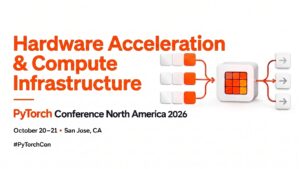
This blog provides a session-by-session guide to PyTorch Conference North America 2026 tracks on getting PyTorch to run fast, portably, and reliably across GPUs, TPUs, NPUs, and custom ASICs.
 Agentic AI and Next-Gen Intelligence Sessions at PyTorch Conference North America 2026
Read this post to learn about sessions scheduled for PyTorch Conference North America 2026 on training agents, serving agents in production, agents that build PyTorch, and PyTorch in the physical world.
 vLLM Sessions at PyTorch Conference North America 2026
At PyTorch Conference North America 2026, there will be vLLM sessions on KV cache management, disaggregated serving, hardware portability, kernel optimization, Mixture-of-Experts inference, and production serving.
 Core PyTorch Sessions at PyTorch Conference North America 2026
This post provides an overview of core PyTorch sessions, spanning compiler and runtime work, distributed communication, device portability, release engineering, CI, observability, and contributor infrastructure.
PyTorch Foundation-hosted Projects Updates

Ray Summit happened in San Francisco and showcased large-scale reinforcement learning and physical AI use cases. A number of Ray improvements were announced.
- Native sandboxing for agents and reinforcement learning was released in Ray. This was built with contributions from Google and Anyscale.
- The Ray history server was introduced to improve the persistence of Ray observability. Contributions came from Alibaba Cloud, Google, and Anyscale.
- GPU-native operators were released in Ray Data, speeding up some workloads 3x. This was built in collaboration by Nvidia and Anyscale.
- Major improvements to Ray’s native RDMA support (via Ray Direct Transport) were released.
- Faster, fault-tolerant joins and aggregations were released with Ray Data’s new shuffle implementation.
- Ray Serve LLM now supports token-load-aware load routing. This integrates Dynamo’s KV indexer and request scoring modules directly into Ray Serve LLM, and was a collaboration between Nvidia and Anyscale.
PyTorch Foundation Ambassador Updates
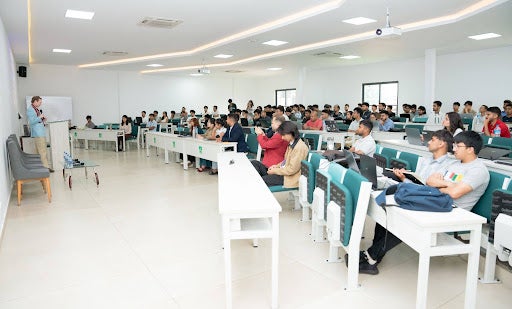 PyTorch Community Engagement in Nepal
From June through August 2026, PyTorch Foundation Ambassador Arun Bhandari organized two community events that engaged more than 260 participants. The PyTorch Meetup Nepal brought together over 200 attendees to explore how PyTorch is driving innovation in artificial intelligence, computer vision, and the broader AI industry. Arun also organized a High Performance Computing workshop webinar attended by more than 60 participants, supporting technical learning and continued community engagement.
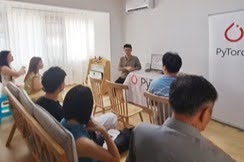 Nanshan Meetup for PyTorch
In August 2026, PyTorch Foundation Ambassador Zhiqing Xiao organized an onsite Nanshan Meetup for PyTorch. The event brought together 10 participants for in-person discussions, knowledge sharing, and community engagement around PyTorch.
Subscribe to the PyTorch Newsletter
Get updates directly to your inbox: https://pytorch.org/newsletter/