

Welcome to the PyTorch Foundation October Newsletter!
I couldn’t be more excited for PyTorch Conference North America next week in San Jose (October 20–21). Since joining the Foundation in February, it’s been incredible to see the breadth of what this community is building, from new research to massive production deployments. I’m looking forward to gathering everyone together in person next week to talk about where we go next.
As a reminder, you can still grab 20% off your registration for PyTorch Conference North America using code FRIEND when you sign up at https://hubs.la/Q04xDGK10.
Feel free to pass this discount along to your team, colleagues, and anyone else who should be in San Jose with us. Our community is at its best when we build and collaborate together, and I look forward to seeing everyone there.
Cheers,
Mark Collier
Executive Director, PyTorch Foundation

What to expect from PyTorch Conference North America
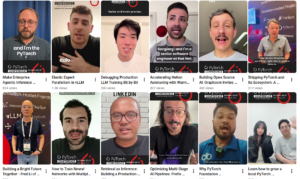 Over the past couple of months, we have published several blogs highlighting technical sessions at the upcoming PyTorch Conference North America.
Across two days, attendees can dive into Core PyTorch internals like torch.compile, dynamic shapes, and distributed communication, along with vLLM sessions on KV cache management, disaggregated serving, and attention. The agentic AI program covers training agents with reinforcement learning, serving them in production, and agents that help build PyTorch itself, while hardware and compute infrastructure sessions explore native PyTorch on TPUs, Trainium, Intel XPU, AMD Instinct, and IBM Spyre. Open research and tooling talks feature open source projects like Helion, Pyrefly, LMCache, and OpenEnv, and Ray users have a dedicated guide to sessions on training, data loading, and post-training at scale.
Newcomers can join the new Introduction Track and the full-day PyTorch Associate Training on October 19, and academic teams can bring their research projects to the Day 0 Academic Workshop.
Check out the YouTube playlist to hear from the speakers themselves why you should attend PyTorch Conference North America: Sneak Peak: PyTorch Conference North America 2026.
Open Source AI Week
 Looking to connect with the open source AI community in the Bay Area? Open Source AI Week is bringing together conferences, hackathons, startup showcases, and networking opportunities focused on the intersection of artificial intelligence, machine learning, and open source technology.
Taking place across the Bay Area from October 16–25, 2026, this week-long event celebrates community-driven innovation and collaborative development in open source AI.
In addition to the PyTorch Foundation events listed above, here are several community events happening throughout Open Source AI Week that we encourage you to explore:
- ExecuTorch Hackathon (Oct 17–18): A hands-on event sponsored by Meta, Qualcomm, GitHub, Open Intelligence Foundation, and the PyTorch Foundation where teams of 3–5 build edge AI applications across Compute, Mobile + XR, or IoT tracks using ExecuTorch; interested participants can register by submitting a project proposal for approval.
- Jupyter Day (Oct 19): Co-located with PyTorch Conference North America, this event brings together data scientists, developers, and researchers to explore interactive computing and AI-assisted workflows; pre-registration is required.
- LF AI & Data Summit 2026 (Oct 19): A mini-summit hosted by the LF AI & Data community to showcase open technologies across the AI lifecycle; pre-registration is required by adding it to your PyTorch Conference North America registration.
- PyTorch, Powering the Enterprise with Red Hat, NVIDIA, and IBM (Oct 19): A day-long event featuring executive discussions and a hands-on workshop on scaling enterprise AI; pre-registration is required (free of charge) via the online event registration page.
- Arm Create with Google, Google DeepMind, Nota, and Renesas (Oct 19): An interactive event featuring live demos, technical experts, and an after-hours session; pre-registration is required online.
- Fine-Tune LLMs on Amazon SageMaker and Run Them On-Device with GenieX (Oct 19): A hands-on workshop co-hosted by AWS and Qualcomm focusing on LoRA fine-tuning and deploying on-device Gen AI runtimes; pre-registration is required.
- AGNTCon + MCPCon (Oct 22–23): A two-day conference dedicated to agentic AI architectures and interoperability protocols like MCP; pre-registration is required by adding the event to your PyTorch Conference registration.
Announcements
 New Pathway to PyTorch Certified Associate (PTCA) Certification
The new PTCA Certification Pathway combines four self-paced learning modules, 15-17 hours of learning and labs, with the PTCA exam in one product through Linux Foundation Education. If you are an early-stage practitioner who wants to start working with PyTorch, this certification pathway is for you. Learn more here.
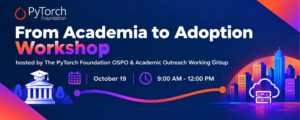 From Research Project to Open Source Ecosystem: Bring Your Academic PyTorch Project to PyTorchCon NA
The OSPO & Academic Outreach Working Group is hosting an Academic Workshop as part of Day 0 programming at PyTorch Conference North America, with lightning talks from eight selected projects and mentor office hours. Registration for this Workshop is separate to PyTorch Conference North America registration, you can register here.
 Session recordings from PyTorch Conference China 2026 now available
PyTorch Conference China 2026 brought the community together in Shanghai on September 8 and 9 alongside KubeCon, CloudNativeCon, and the OpenInfra Summit. For those who were unable to attend in person, you can now check out the session recordings on the PyTorch Foundation YouTube channel: KubeCon + CloudNativeCon + OpenInfra Summit + PyTorch Conference China 2026
Upcoming Events
 PyTorch Conference 2026 (North America), San Jose, CA, October 20-21, 2026
PyTorch Conference North America 2026 will take place next week in San Jose, CA on October 20-21, bringing together AI leaders, researchers, and developers to explore open-source AI advancements across the full technology stack. Register here.
 PyTorch Meetups Madrid (Spain), Madrid, Spain, October 14, 2026
A free community meetup happening today in Madrid. The event listing is in Spanish and welcomes attendees to PyTorch Meetups Madrid. Join here.
 NVIDIA GTC Berlin, Germany, Berlin, Germany, October 20-22, 2026
NVIDIA’s AI conference for developers, researchers, and industry leaders, with a keynote from CEO Jensen Huang and sessions on AI infrastructure. Learn more here.
 Since AI Hackathon 2026, Turku, Finland, November 6-8, 2026
A free, 72-hour onsite AI build event bringing together 1,000+ participants from AI, software, data, product, and other fields. Learn more here.
 PyTorch Day Korea 2026, Seoul, Korea, November 21, 2026
The first large-scale offline conference hosted by the PyTorch Korea User Group. Learn more here.
 NVIDIA GTC Washington, D.C., Washington D.C, United States, November 30-December 3, 2026
NVIDIA GTC brings together government leaders, policymakers, scientists, and industry partners to discuss how AI is accelerating economic growth, reindustrialization, and scientific discovery. Learn more here.
NeurIPS 2026, Sydney, Australia, December 6-12, 2026
The PyTorch Foundation is sponsoring NeurIPS 2026, the annual Conference on Neural Information Processing Systems. Learn more here.
 PyTorch Day Japan 2026, Tokyo, Japan, December 10, 2026
Hosted by the PyTorch Foundation, Hugging Face, IBM, and Mitsubishi Electric, with a full day of technical talks and discussions on open source AI and PyTorch Foundation projects. Learn more here.
Past Events
 PyTorch Community Meetup Kampala, Kampala, Uganda, September 19, 2026
Hosted by the PyTorch East Africa Community with the IndabaX and IEEE Computer Society student chapters at Makerere University, this free meetup was designed to bring together students, researchers, and practitioners for talks and discussion on PyTorch, machine learning, and open source AI. Learn more here.
Blogs
 How Shopify built a continual learning loop with PyTorch and vLLM
A case study on how Shopify turns production failures into training signal every day, using PyTorch for training and vLLM for serving. For its GraphQL agent, the approach beat frontier-model quality and cut estimated serving costs by 96%. Read the case study
 Evolution of the PyTorch Media Processing Landscape
Over the past two years, PyTorch has consolidated its media stack into three specialized libraries: TorchCodec handles all centralized decoding and encoding for images, video, and audio across CPU and CUDA, while TorchVision and TorchAudio now focus exclusively on their core media transformation capabilities.
 PyTorch Hardware Enablement: Updates from the Accelerator Integration Working Group
The PyTorch TAC Accelerator Integration Working Group H1 2026 update details key technical achievements such as Cross-Repository CI Relay (CRCR), test suite refactoring, profiling stubs, and reference backends for distributed execution (OCCL) and compilation – that establish clear, vendor-neutral standards to streamline PyTorch hardware enablement across diverse compute platforms.
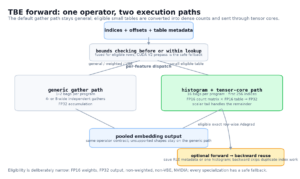 Modernizing Table Batched Embeddings with FBTriton
Meta’s FBTriton kernel design modernizes Table Batched Embedding (TBE) forward and backward passes using ordinary Python, successfully outperforming legacy CUDA implementations on recommendation system workloads while unlocking future opportunities for complete forward, backward, and optimizer fusion.
 Building Spyre as a Native PyTorch Device
IBM’s Spyre becomes a native PyTorch device by connecting PyTorch’s device, allocator, stream, event, and compiler abstractions to the Spyre runtime and firmware, enabling lower launch overhead and a unified path for eager and compiled execution.
 Session-Aware Agentic Inference with NVIDIA Dynamo
NVIDIA Dynamo uses a unified session-level identifier to transform request-level serving infrastructure into a program-aware system, unlocking session-aware routing, shared KV cache indexing, and programmatic cache movement across vLLM and SGLang.
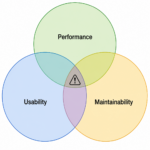 Building a High-Performance and Portable vLLM Linear Backend with Helion
Engineers from Red Hat and Meta integrated Helion into vLLM’s linear backend, using one autotuned GEMM implementation to cover Standard, Split-K, and Swap-AB variants. On NVIDIA Hopper GPUs it outperformed the default CUTLASS and DeepGEMM backends, with more than 10% throughput gains for some workloads.
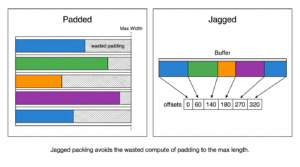 Optimizing Jagged Flash Attention with TLX: The Road Toward SOTA FA4 on Blackwell
A Meta team details a TLX-based attention kernel for Meta’s Generative Ads Model on NVIDIA Blackwell. It uses about 3.2K lines of code, roughly 3x fewer than FlashAttention-4’s CuteDSL kernels, and outperforms FA4 on jagged shapes by about 13% forward and 50% backward.
 From Upstream Changes to Downstream Confidence: Inside Torch Spyre’s Integration with PyTorch CRCR
IBM and Red Hat engineers explain how Torch Spyre reached L2 integration with PyTorch’s Cross-Repository CI Relay, using an agentic test-selection pipeline and a declarative YAML test-reuse framework. The authors plan to work with the PyTorch team to upstream the reusable parts.
 Hardware-Agnostic Models in vLLM
vLLM is adding hardware-agnostic layers so frontier-focused changes do not break torch.compile support for out-of-tree accelerators, older GPUs, and exotic models. On NVIDIA H100 GPUs, throughput landed within 3.4% of the native implementation (geometric mean across three models).
 TinyTorch: Don’t Just Import PyTorch. Build It.
TinyTorch is a free, open-source curriculum of twenty modules where learners build a working ML framework from scratch, tensors through transformers, in pure Python using PyTorch’s API. It runs on a laptop with 4 GB of RAM and no GPU.
 Extending Inductor for the IBM Spyre Accelerator
IBM updated its PyTorch software stack for the Spyre enterprise inference accelerator by transitioning to an out-of-tree PyTorch Inductor backend, achieving a nearly 7x reduction in compiler code size while effectively addressing Spyre’s custom dataflow, scratchpad memory, and core assignment architecture.
PyTorch Foundation-hosted Projects Updates

`0.9.0` is currently in the works; a release candidate has been published. We are releasing a new `prefetch` API, which brings massive speed improvements. Currently only compatible with Linux and CUDA backends.
The main idea behind this feature is that after opening, once you call `prefetch`, the tensors you declare in the plan are loaded asynchronously with an optimised transport. The basic flow is `pread -> pinned memory -> cudaMemcpyAsync`; note the “async” memcpy, this allows us to overlap disk reads and data transfer to the device.
We’ve observed almost 10x improvements in transformers and over 200x in vllm (GLM 5.2 FP8, cold load ~1h -> ~14s)!
Subscribe to the PyTorch Newsletter
Get updates directly to your inbox: https://pytorch.org/newsletter/