
Featured projects

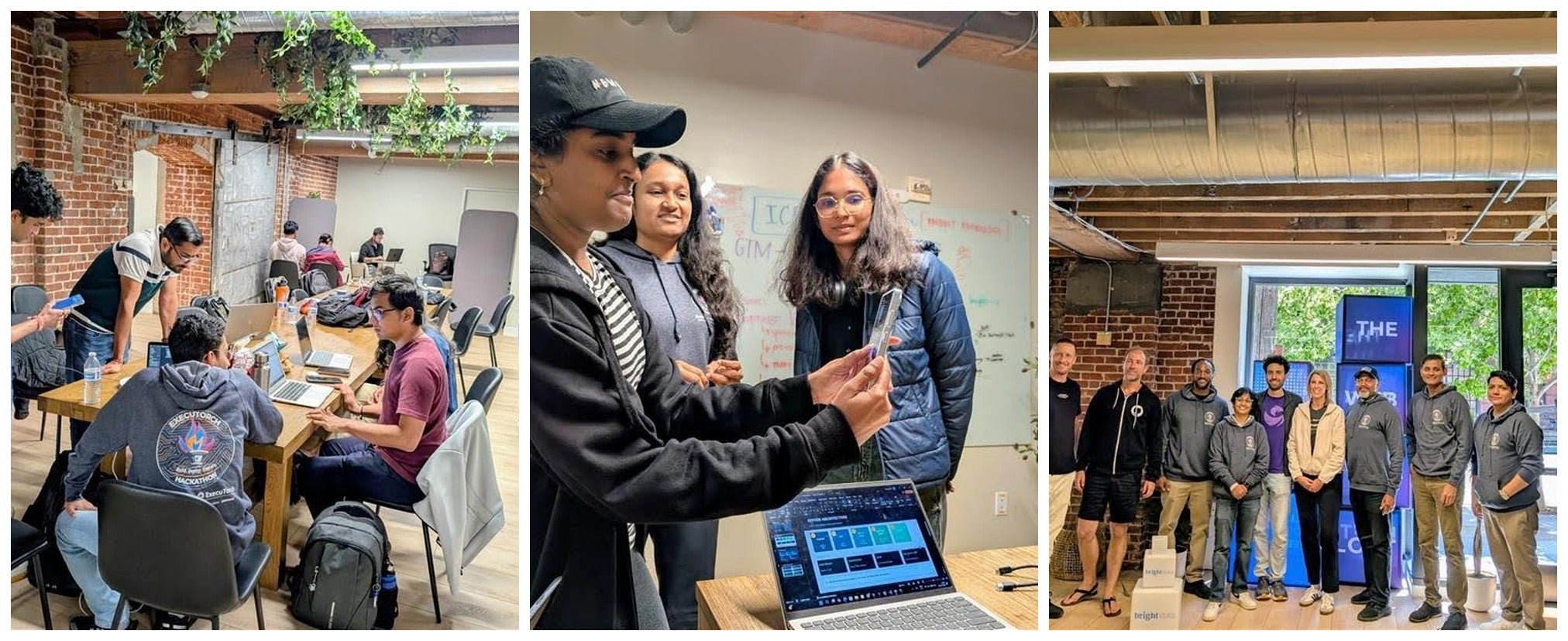
This past weekend in San Francisco, builders, researchers, mobile developers, and AI practitioners came together for the ExecuTorch Hackathon, a two-day, on-site event focused on a practical and increasingly important question: what can we build when powerful AI runs locally on the device in your hand? Held June 27–28, 2026, the hackathon challenged teams to build and optimize real-time AI applications that run directly on Snapdragon-powered mobile devices using ExecuTorch. Participants built on Samsung Galaxy S25 Ultra devices powered by Snapdragon, with workshops, mentorship, and hands-on support from Qualcomm and Meta experts.
The event was hosted with support from Qualcomm, Meta, GitHub, the PyTorch Foundation, and others, with Samsung serving as a hardware partner for the Snapdragon-powered Galaxy S25 Ultra devices used by teams on-site. The format was intentionally hands-on: teams were asked to design, build, and demo real user-facing applications that run locally using PyTorch and ExecuTorch, with an emphasis on latency, offline capability, privacy-sensitive processing, energy efficiency, and real-time user experience.
The energy in the room was unmistakable from the start. Developers arrived ready to build, and that momentum lasted all weekend. Across workshops, mentor sessions, debugging conversations, live testing, and final demos, there was a clear and sustained interest in moving AI beyond cloud-only deployment patterns and into resource-constrained edge environments. The strongest projects did more than show that models could run locally; they demonstrated why local execution matters for real products, especially where responsiveness, privacy, cost, and connectivity are central to the user experience.
That is exactly where ExecuTorch fits. ExecuTorch is an end-to-end solution for enabling on-device inference across mobile and edge devices, including wearables, embedded devices, and microcontrollers. It is part of the PyTorch Edge ecosystem and enables efficient deployment of PyTorch models—including vision, speech, and generative AI models—to edge devices. Its value proposition is centered on portability across device classes, productivity through familiar PyTorch toolchains, and performance through a lightweight runtime that can take advantage of CPUs, NPUs, DSPs, and other hardware capabilities.
The event drew significant participation, with over 100 participants across 20+ teams. The submissions reflected the breadth of the edge AI opportunity: accessibility tools, privacy-first assistants, visual safety systems, offline document intelligence, mobile generative AI workflows, medical and industrial support tools, and more.
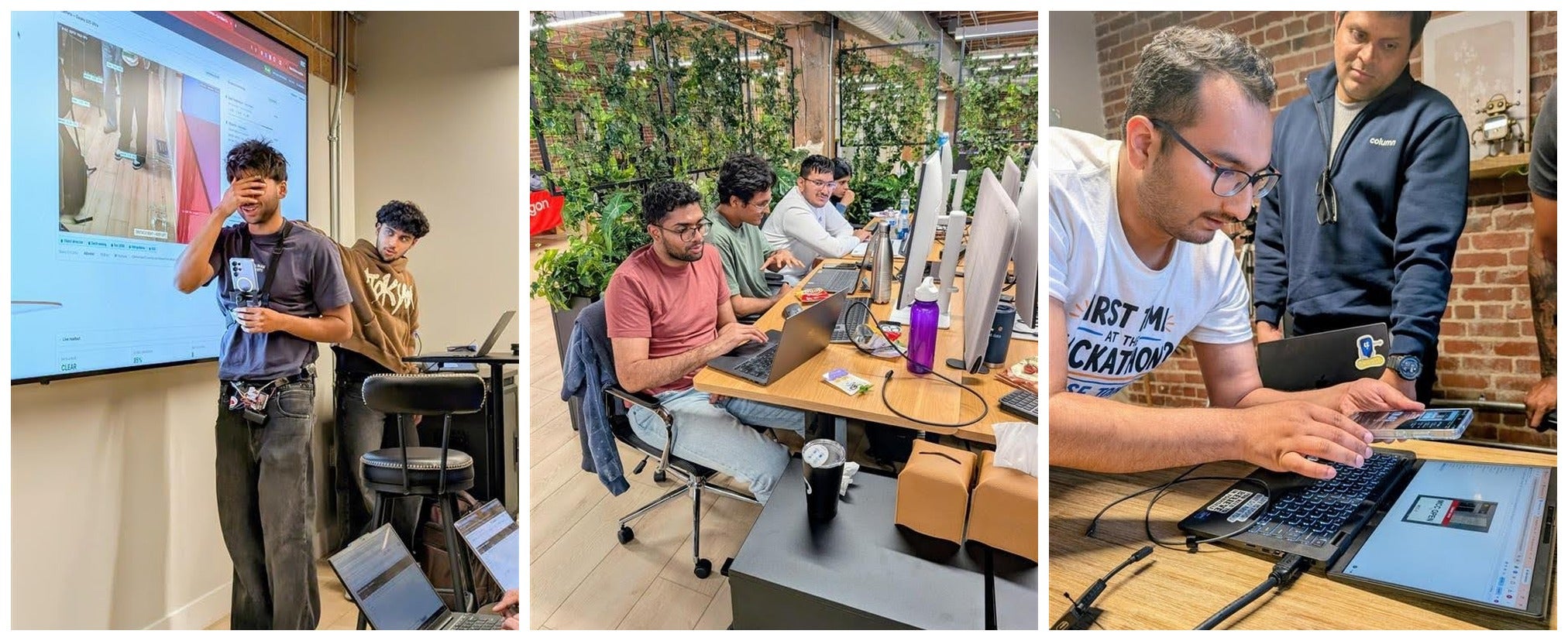
Congratulations to the winning teams:
1st Place: SafeScreen AI
SafeScreen AI took first place with a timely and ambitious application: a local, on-device visual safety layer designed to help protect users from explicit, abusive, and manipulated media before they fully engage with it. The app runs directly on a Snapdragon-powered Android device using ExecuTorch and analyzes visual content on-device in real time. When potentially harmful content is detected, the system can warn, blur, redact, mask, or block that content directly on screen.
SafeScreen AI stood out because it connected edge AI performance to a clear human need. By keeping visual analysis local, the project emphasized low latency and privacy-preserving protection—two qualities that are difficult to achieve if sensitive images or videos must be sent to a remote server first. The project also showed how on-device AI can become a proactive user safety layer, not just a passive detection system.
2nd Place: SixthSense
Second place went to SixthSense: Haptic Vision for the Blind, an assistive wearable that uses a phone-mounted camera and local AI models to help blind and low-vision users navigate physical spaces. The system interprets what the camera sees, separates obstacles into left, center, and right zones, and sends directional vibration signals to a belt worn at the waist so users can feel where obstacles are and move toward clearer paths.
SixthSense captured one of the most compelling promises of edge AI: making assistive technology more accessible, responsive, and affordable. The project used on-device models for object detection, depth estimation, spoken interaction, and text reading, with models running through ExecuTorch on the phone. By avoiding dependence on continuous connectivity, the team created a prototype that could be more useful in crowded, noisy, or network-constrained environments where immediate feedback matters.
3rd Place: Toddle AI
Toddle AI earned third place with a privacy-first Android prototype designed to help parents capture and understand toddler walking patterns. The app can record or import walking videos, evaluate whether the clip is usable, run pose estimation locally using a 33-landmark body model, and apply an explainable gait-analysis pipeline to identify steps and generate structured observations. It also includes a local AI assistant that explains results in parent-friendly language without sending raw video to a server.
Toddle AI was a strong example of how local AI can support sensitive personal workflows. The project avoided black-box diagnosis and instead focused on measurable observations, capture quality, explainability, and privacy. It showed how edge AI can help users better understand data captured in everyday environments while keeping sensitive video on the device.
Across all three winning projects, a common pattern emerged: the most compelling applications were not simply “AI on a phone.” They were applications where local execution was essential to the product experience. SafeScreen AI needed immediate, private intervention. SixthSense needed real-time, directional feedback. Toddle AI needed privacy-preserving analysis of sensitive family video. These are precisely the kinds of use cases where edge AI can change what developers are able to build.
The weekend also highlighted the importance of optimizing for real constraints. Developers were not building in an abstract environment. They were working with real mobile hardware, real performance considerations, real battery and latency tradeoffs, and real user experience expectations. That made the event especially valuable: participants had to move from model ideas to deployable applications, and from demos to systems that could plausibly work in users’ hands.
For the PyTorch community, this is an exciting signal. PyTorch has long been valued for its flexibility, usability, and research-to-production workflow. ExecuTorch extends that developer experience to the edge, helping teams bring PyTorch models into environments where compute, memory, power, and connectivity are constrained. The hackathon showed that developers are ready for this shift. They want to build AI that is local, responsive, private, efficient, and useful.
We are grateful to every participant, mentor, judge, organizer, and partner who made the ExecuTorch Hackathon possible. The excitement lasted all weekend because the opportunity is real: on-device AI is becoming a practical development target, and the community is eager to explore it. SafeScreen AI, SixthSense, Toddle AI, and the full set of submitted projects offered an early look at what builders can create when PyTorch models move efficiently onto edge devices through ExecuTorch.
The future of AI will not be defined by one deployment model. It will include cloud, edge, hybrid, and fully local experiences. This weekend made one thing clear: the edge is ready for builders, and builders are ready for the edge.