PyTorch 2.14 Release Blog
We are excited to announce the release of PyTorch® 2.14 (release notes)! The PyTorch 2.14 release features the following changes: NVGEMM brings CuTeDSL-generated CUTLASS kernels to Inductor, with epilogue fusion,...
TL;DR PyTorch Conference North America 2026 features Agentic AI and Next-Gen Intelligence across sessions on training agents, serving agents in production, agents that build PyTorch, and PyTorch in the physical...
TL;DR PyTorch Conference North America 2026 features Core PyTorch sessions spanning compiler and runtime work, distributed communication, device portability, release engineering, CI, observability, accelerator integration, and contributor infrastructure. Core PyTorch...
TL;DR The AI model landscape never stops moving, and the software stack that runs those models is always a step behind: even on a mature compilation stack, a new model...
At the PyTorch Conference 2025, we demonstrated linear scaling beyond 1,000 GPUs on AMD Instinct clusters using Primus-Turbo, an AMD optimization library for training frameworks such as TorchTitan. We have since upstreamed those AMD optimizations so TorchTitan supports AMD Instinct(™) GPUs directly, with competitive FP8 performance out of the box. All contributions mentioned have been…
Today, Meta introduced Muse Glimmer, an open-weight, 30-billion-parameter model distilled from Meta’s Muse Spark for on-device agentic workflows. Alongside, ExecuTorch is adding end-to-end support for running Muse Glimmer on NVIDIA...
TL;DR The inaugural Santa Cruz PyTorch Meetup brought together 45 local engineers, students, and leaders for GPU/CUDA talks and lightning presentations on chemistry, plant health, and autonomous driving – demonstrating...
TL;DR In April 2025, the PyTorch Foundation evolved into a multi-project Foundation, with the objective to support deeper collaboration across domains and help scale innovation throughout the AI lifecycle. Today,...
TLDR The PyTorch-Triton 3.7 release introduces the Triton Plugin Extensions system, a framework for dynamically loading custom compiler passes, dialects (including their ops), and DSL extensions into upstream Triton at...
We are excited to announce the release of PyTorch® 2.13 (release notes)! The PyTorch 2.13 release features the following changes: FlexAttention lands on Apple Silicon (MPS), with up to...
Training state-of-the-art large language models (LLMs) with billions of parameters requires distributed training across hundreds or thousands of GPUs. At this scale, hardware failures are not exceptional events—they are expected....
TL;DR PyTorch tests are often generated at import time, so CI failures may show device/dtype-specific names that differ from the source template. For local debugging, pytest -k and test/run_test.py are...
This past weekend in San Francisco, builders, researchers, mobile developers, and AI practitioners came together for the ExecuTorch Hackathon, a two-day, on-site event focused on a practical and increasingly important...
TL;DR Miles is RadixArk’s open source framework for large-scale LLM RL post-training. It composes SGLang for rollout, NVIDIA Megatron-LM for training, Ray orchestration, and PyTorch-native extensibility behind a small, pluggable...
TL;DR PyTorch now has a Cross-Repository CI Relay (CRCR) that automatically triggers and tracks CI in downstream repositories whenever a PR is opened or a commit is pushed against pytorch/pytorch....
TL;DR Eighty engineers, researchers, and community builders gathered for the inaugural PyTorch Meetup Singapore. Hosted at the Red Hat Asia Pacific office and organised by Sudhir Dharanendraiah, Ayush Satyam, Sumantro...
TL;DR: This case study demonstrates how LinkedIn re-architected its distributed linear programming solver, DuaLip, by developing a GPU-accelerated PyTorch version to handle extreme-scale optimization challenges like web applications. This transition...
TL;DR: The TokenSpeed inference engine achieved a record-breaking 580 tps running the Qwen3.5-397B-A17B model on GPUs. This extreme performance for agentic workloads is driven by systematic elimination of memory copies,...
A little over a year ago, the PyTorch Foundation launched the Ambassador Program, an initiative that recognizes and supports independent, trusted voices in the PyTorch community who are passionate about...
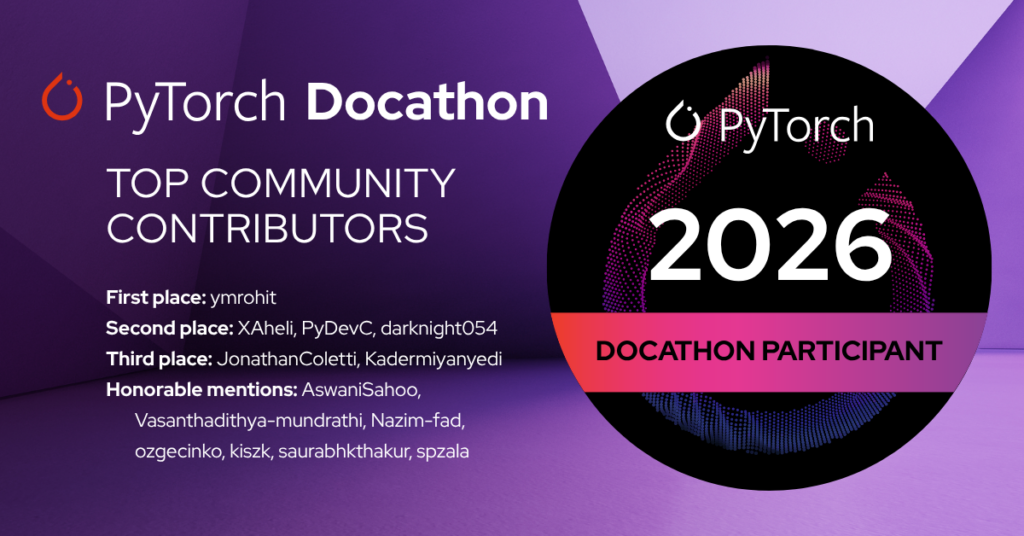
Thank you to everyone who participated in the PyTorch Docathon 2026! Once again, the community showed up with incredible energy and dedication to make PyTorch documentation better for developers everywhere....