
Featured projects

TL;DR: Introducing the ExecuTorch MLX Delegate
- The new MLX delegate enables optimized, GPU-accelerated inference for PyTorch models on Apple Silicon Macs, using Apple’s MLX framework.
- The delegate seamlessly integrates with the PyTorch 2 export stack and supports a wide range of quantization options (BF16, FP16, FP32, 2/4/8-bit affine, NVFP4).
- It supports various models, including dense transformers (Llama, Qwen, Gemma), sparse Mixture-of-Experts, and speech-to-text models (Whisper, Voxtral, Parakeet) for both offline and real-time transcription.
- Note: The MLX delegate is currently experimental.

Apple Silicon has become a popular platform for running large language models locally. Until now, ExecuTorch users on macOS were limited to CPU-based backends like XNNPACK or the AOTI Metal backend. Now we’ve released the MLX delegate, which brings fully optimized GPU-accelerated inference to Apple Silicon Macs through Apple’s MLX framework.
In this post we’ll cover what the MLX delegate is, why we built it as an ExecuTorch backend, and what you can run with it today.
Note: The MLX delegate is currently experimental and under active development. APIs and supported features may change.
What is the MLX Delegate?
The MLX delegate is a new ExecuTorch backend that compiles and runs PyTorch models on Apple Silicon GPUs. You export your model using the standard ExecuTorch pipeline, and the delegate handles the rest: partitioning the graph, serializing it into an optimized format, and dispatching operations to MLX’s Metal GPU kernels at runtime.
From the user’s perspective, the workflow is the same as any other ExecuTorch backend:
- Export your model with
torch.export - Lower it with
to_edge_transform_and_lowerusing theMLXPartitioner - Run the resulting
.ptefile with the ExecuTorch runtime
The delegate currently supports around 90 ATen ops, covering the full range of operations needed for transformer inference: quantized matmul, multi-head attention, rotary position embeddings, mixture-of-experts routing, recurrent state-space operations, and more.
Why Build This as an ExecuTorch Delegate?
There are already excellent tools for running models on Apple Silicon, including MLX’s own mlx-lm. So why build another one? Three reasons:
Performance. The MLX delegate achieves 3-6x higher throughput on generative AI workloads compared to existing ExecuTorch delegates on macOS. Moving inference to MLX’s optimized Metal kernels makes a meaningful difference for ExecuTorch applications like chat and real-time transcription.
PyTorch 2 integration. The delegate plugs directly into the PyTorch 2 export stack. It uses torch.export for graph capture and TorchAO for quantization, the same tools used by every other ExecuTorch backend. If you can export a model with torch.export, you can run it on MLX. When new models or quantization techniques land in PyTorch, they become available to the MLX delegate without additional work.
Portable applications. ExecuTorch provides a single runtime API across all backends. An application built against the ExecuTorch C++ or Python runtime can run models exported for MLX, XNNPACK, CoreML, Vulkan, or CUDA without changing application code.
Quantization and Dtype Support
The delegate supports the precision and quantization options you’d expect for on-device inference:
- BF16, FP16, and FP32 for weights and activations
- 2, 4, and 8-bit affine quantization via TorchAO’s
quantize_API. This uses the same quantization scheme as the XNNPACK and Vulkan backends, which means a single quantized model definition can target multiple backends, and opens the door to fat PTE files that run on whichever backend is available at runtime. - NVFP4 quantization using NVIDIA’s FP4 data type
- Tied quantized embeddings for models that share weights between the embedding layer and the language model head
What Models Can I Run?
We’ve validated the delegate across a range of architectures:
Large Language Models
Dense transformers work out of the box, with support for both full KV caches and sliding window caches:
- Llama 3.2 1B
- Qwen 3 (0.6B, 1.7B, 4B)
- Phi-4 mini (3.8B)
- Gemma 3 (1B, 4B) with sliding window attention
Sparse Mixture-of-Experts models are supported through custom gather operations that efficiently route tokens to the correct experts on the GPU:
- Qwen 3.5 35B-A3B: 256 experts with top-8 routing, combining GatedDeltaNet linear attention layers with full SDPA attention layers
Speech-to-Text
Offline transcription models process a complete audio recording and return the transcript:
- OpenAI Whisper (tiny through large-v3-turbo)
- NVIDIA Parakeet TDT (0.6B) with word-level timestamps
- Mistral Voxtral (3B)
Real-time streaming transcription processes audio in small chunks as it arrives, enabling live use cases:
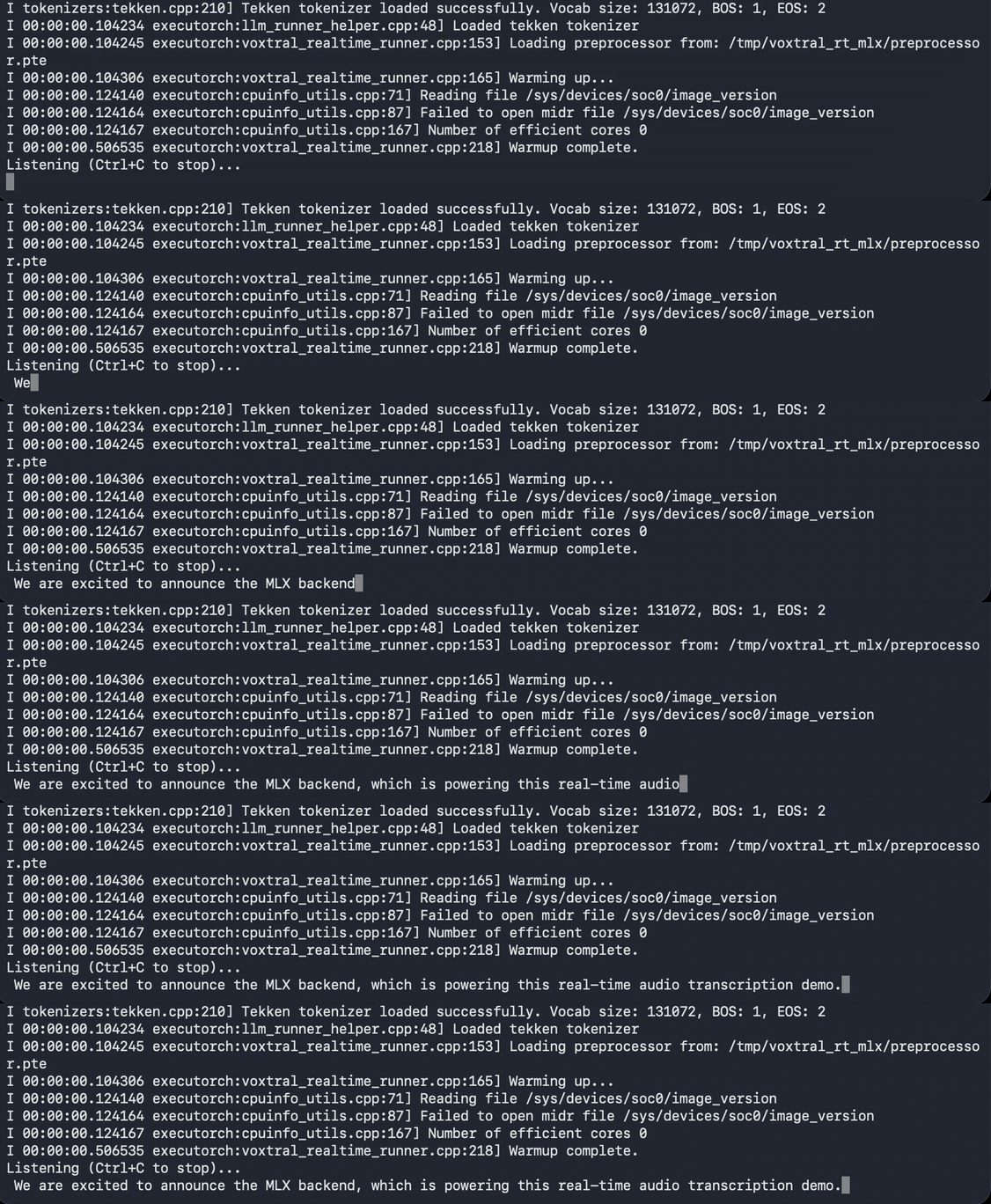
- Mistral Voxtral Realtime (4B) with live microphone input, ring buffer KV caches, and sliding window attention
Broader Coverage
Beyond these flagship models, over 30 additional models have been validated through our backend test suites, covering dense transformers, encoder-decoder architectures, and vision models.
Getting Started
Each supported model has a README with detailed export and inference instructions:
- LLMs via HuggingFace: covers Llama, Qwen, and Gemma using optimum-executorch
- LLMs via export_llm: covers Phi-4 and Stories 110M using the Hydra-based pipeline
- Qwen 3.5 MoE: covers the sparse MoE export with `–backend mlx`
- Voxtral Realtime: covers streaming and offline speech-to-text
- Parakeet: covers speech recognition with timestamps
- Whisper: covers OpenAI’s speech recognition models
For an overview of the delegate architecture, supported operations, and development guide, see the MLX Delegate README.
We’d love to hear what models and use cases matter most to you. If you run into issues or have feature requests, please open an issue on the ExecuTorch GitHub repo or join our Discord Channel.