
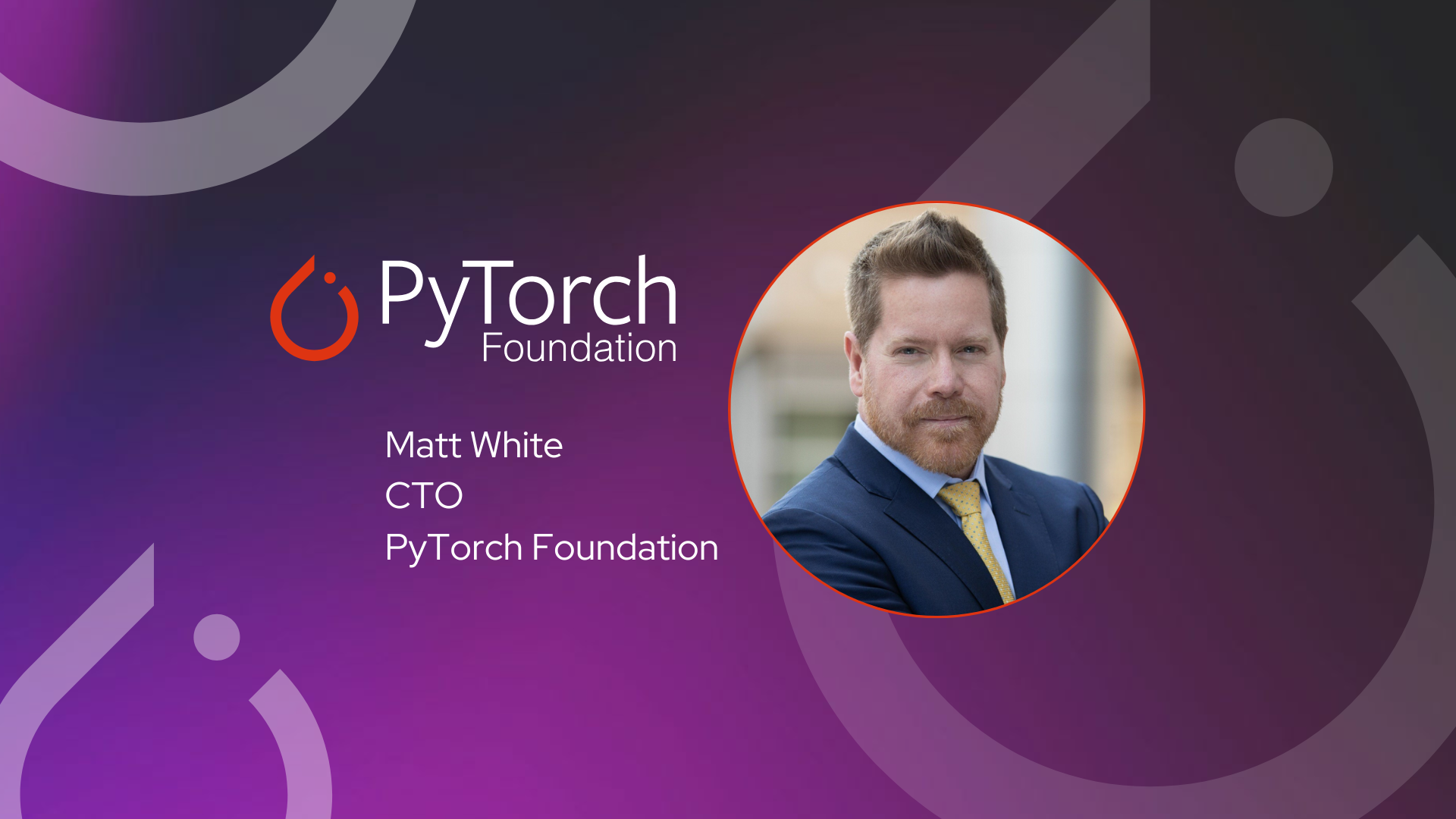
Over the past nearly two years, I’ve had the privilege of serving as Executive Director of the PyTorch Foundation. As I look back on what we have accomplished together, one thing stands out clearly: our momentum is not accidental. It is the result of a global community of maintainers, contributors, researchers, practitioners, member organizations, and volunteers who have chosen collaboration, openness, and technical rigor as the path to progress.
This post is both a thank you and a transition update, shared first and foremost with the PyTorch community.
What we built in a short time
In a relatively short period, the PyTorch Foundation has evolved from a single-project foundation centered on PyTorch into a multi-project home for critical components across the AI development lifecycle. Today, the Foundation proudly hosts four major projects: PyTorch, vLLM, DeepSpeed, and most recently Ray. Alongside these hosted projects, the broader PyTorch ecosystem has expanded to more than 100 projects, including Unsloth, verl, SGLang, FEAST, and many other high-quality open source efforts that are pushing the state of the art forward.
At the same time, our membership has grown to 33 organizations, nearly doubling, and we updated our membership tiers to better reflect the scale and maturity of our ecosystem. Those member commitments matter, because they translate into real investment in the shared infrastructure and community programs that enable open source AI to thrive.
Stronger governance and deeper technical collaboration
As our technical scope expanded, so did our governance. We launched the initial Technical Advisory Council and supported its growth into a more active forum for cross-project alignment. We also established five core working groups: CI Infrastructure, Multi-Cloud, Ecosystem, Accelerators, and Security.
These groups are where hard, practical problems get solved: keeping CI reliable and scalable, improving portability and cost efficiency, coordinating cross-project priorities, strengthening security posture, and making it easier for developers and organizations to adopt and deploy PyTorch and related projects. The result has been measurably increased technical engagement, clearer project roadmaps, and more consistent collaboration patterns across the Foundation’s hosted projects and the broader ecosystem.
A bigger global footprint, powered by the community
The growth of PyTorch is global, and our community programs have expanded accordingly.
We grew from a conference of roughly 300 attendees to a flagship PyTorch Conference in San Francisco that welcomed more than 3,000 participants. We successfully launched PyTorch Days with events in Paris and Beijing, and we are continuing to expand our global presence. In 2026, we will hold three PyTorch Conferences: Europe in Paris (April), China in Shanghai (September), and our flagship event, North America in San Jose (October). These will be complemented by additional PyTorch Days, starting in Bengaluru this past weekend, with more events in development, including Beijing, Seoul, and others.
We also launched the PyTorch Ambassadors program, now approaching 50 ambassadors, with another cohort planned. This is one of the most important community programs we run, because it scales something no single team can manufacture: local leadership. Ambassadors host meetups, welcome new contributors, and help PyTorch show up meaningfully in regions and communities around the world. In parallel, we’ve been building a speaker bureau to connect domain experts from the community with events seeking credible technical speakers.
Academic outreach, research engagement, and education
Another area of focus has been strengthening ties between research, education, and open source practice.
We kicked off an Academic and OSPO outreach program to engage academic labs and university Open Source Program Offices, with early work involving UC Berkeley, UC Santa Cruz, Stanford, the University of Vermont, and Caltech. The goal is to help students build practical open source skills, create clearer pathways from research to production, and identify emerging open source AI projects that could benefit from Foundation support.
We also increased the Foundation’s participation in major research and practitioner venues, supporting workshops, posters, and talks at MLSys, ICML, NeurIPS, and UC Berkeley’s AgentX program. Across the year, I joined many leaders from the PyTorch community in speaking at more than 100 events worldwide to advocate for PyTorch, the Foundation, and open source AI as a durable strategy for innovation.
Finally, the educational output from the community has been exceptional. In 2025, we published more than 130 pieces of educational content, including tutorials, webinars, and blogs, averaging nearly one substantive item every three days. That pace reflects both the depth of expertise across the community and the rate at which the ecosystem continues to evolve.
We also made meaningful progress toward scalable professional development. At the last PyTorch Conference, we kicked off onsite training for the PyTorch Certified Associate program with strong participation. In the coming months, we expect to publish the corresponding exam and online course, and then begin building the content pathway toward a PyTorch Certified Professional designation. The intent is to support developers who want to demonstrate practical PyTorch fluency, while giving employers a clearer signal for hiring and workforce development.
Infrastructure that scales with the ecosystem
Behind every reliable open source ecosystem is infrastructure that works. Over the past two years, we continued strengthening CI reliability and observability, expanded monitoring and logging, and progressed the migration of our download site to the Cloudflare CDN.
Just as importantly, the Foundation’s CI would not be sustainable without the support of member organizations and partners who contribute engineering effort, hardware, and operational expertise. Contributions, current and in progress, from Meta, AWS, AMD, Intel, Microsoft, and NVIDIA have been critical. We have also advanced a multi-cloud strategy so we can diversify our footprint across hyperscalers and neo-clouds, manage cost, and maintain the performance and scale that developers and production users depend on.
What comes next
Even with this progress, the next phase demands more. Key priorities ahead include:
- Expanding the hosted project portfolio, including adjacent domains such as agentic AI, environments, and reinforcement learning
- Further diversifying and optimizing CI architecture and costs
- Onboarding additional project CI workloads where shared accelerator access unlocks faster iteration
- Expanding training and certification into a durable revenue stream that strengthens Foundation sustainability
- Deepening community programs, including initiatives such as mentorship and stronger global enablement
As the scope grows, there is a straightforward operational reality: leadership capacity must scale so that organizational throughput, not leadership bandwidth, sets our pace.
A leadership transition to support the next stage
To support this next stage, I’m sharing a leadership transition that takes effect immediately.
I will be stepping into the role of Chief Technology Officer for the PyTorch Foundation, alongside my new role as Global CTO of AI at the Linux Foundation. At the same time, Mark Collier will join the PyTorch Foundation as our new Executive Director.
Mark brings deep experience building and scaling open infrastructure ecosystems, including founding OpenStack and the OpenInfra Foundation. As Executive Director, he will lead the operational and business execution of the Foundation, working closely with the Governing Board. His responsibilities include oversight of Foundation committees (including Finance and Marketing), community programs such as Ambassadors, Foundation-led events, staff management, finances, and membership development. Ultimately, he will be accountable for the overall direction and operations of the Foundation in partnership with the Governing Board.
As CTO, I will focus on technical strategy and execution across the Foundation: supporting the TAC and working groups; advancing our hosted projects and ecosystem alignment; strengthening CI and multi-cloud infrastructure; and driving technical programs, including Academic and OSPO outreach and PyTorch Certified. This structure is intended to increase clarity, accountability, and speed, while preserving community-led technical governance.
Quotes
“It’s great to see the PyTorch Foundation enter a new phase, just months after it evolved into an umbrella foundation. With Mark as the Executive Director and Matt as the CTO, the foundation acquires the level of maturity required by its ambitions. I can’t wait to help build the future of PyTorch with the new leadership and the rest of the TAC.”
– Luca Antiga, CTO, Lightning AI and Chair, PyTorch Foundation Technical Advisory Council (TAC)
“Watching the PyTorch Foundation grow into an umbrella ecosystem has been inspiring—it’s set PyTorch up not only for the short term, but for a long arc of impact foundational to AI. Congrats to Matt on an incredible chapter, and a warm welcome to Mark. I’m excited for where we take PyTorch next!”
– Joe Spisak, Product Director, Meta Superintelligence Labs & PyTorch Core Maintainer
“The growth of the PyTorch Foundation speaks for itself. Thanks to Matt White for everything he has built. What began as a single-project foundation is now a multi-project home for some of the most critical infrastructure in AI. That did not happen by accident. It is the result of real technical leadership, genuine community investment, and a clear belief in open collaboration. I’m excited to keep that momentum going that will define what’s possible next.”
– Mark Collier, Executive Director, PyTorch Foundation
Thank you
I want to close with an explicit note of appreciation. The PyTorch Foundation’s progress is not the product of any single organization or individual. It is the result of thousands of community members: maintainers, contributors, reviewers, working group participants, event organizers, speakers, educators, and member company teams who consistently choose collaboration over fragmentation and long-term stewardship over short-term advantage.
Thank you for the trust, the effort, and the standards you bring to this community.
I’m excited for what comes next, and I’m particularly looking forward to working with Mark as he steps into the Executive Director role. Please join me in welcoming him and supporting him as he begins this next chapter with us.
We have built something strong. Now we scale it.
Matt White
CTO, PyTorch Foundation
Global CTO of AI, Linux Foundation