
- This event has passed.
PyTorch 2.10 Release Live Q&A
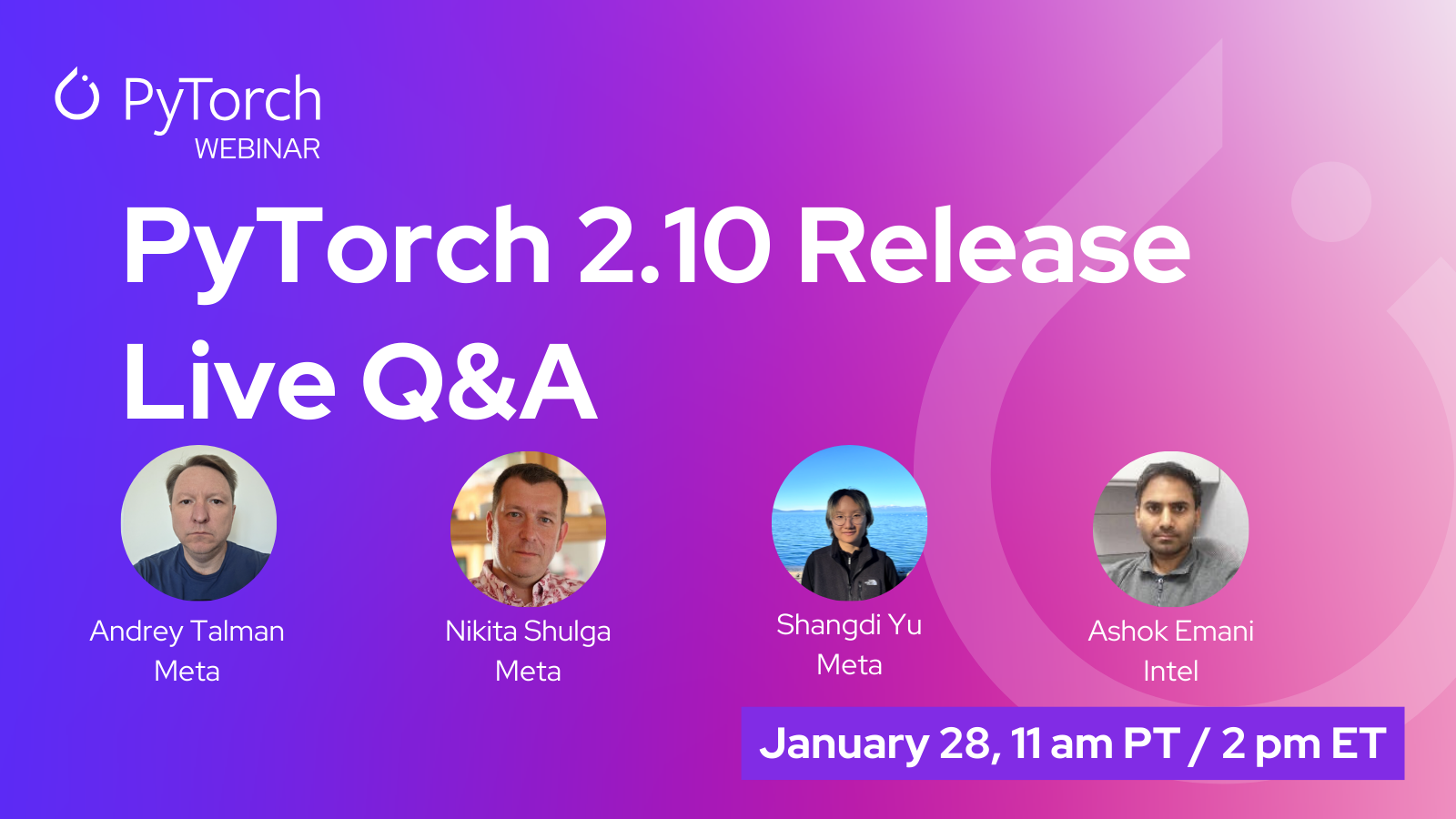
The PyTorch 2.10 release features a number of improvements for performance and numerical debugging. On Wednesday, January 28th, Andrey Talman, Nikita Shulga, Shangdi Yu, and Ashok Emani gave a brief update on the release and answered your questions. Watch here. Topics:
- Release cadence updates link.
- TorchScript deprecation
- Torch Compile Support for Python 3.14
- Continuing support Wheel-Variant in release 2.10. PEP 817 was published. Link
- DebugMode and tlparse
- Deprecating Volta support for cuda 12.8 builds, starting release 2.11. Link
- Remind about Linux aarch64 CUDA binaries availability since release 2.9. The instructions for these are now visible on getting started page
- TorchAudio migration finalization: TorchAudio 2.10 marks the finalization of the ongoing migration, and should be the last major release in the foreseeable future. Based on user feedback, some critical optimized ops like lfilter, which were originally slated for deletion, are preserved!
- Intel GPUs support: Expand PyTorch support to the latest Panther Lake on Windows and Linux by enabling FP8 (core ops and scaled matmul) and complex MatMul support, and extending SYCL support in the C++ Extension API for Windows custom ops.
Bios:
Andrey is a Software Engineer at Meta, primarily focused on open-source releases for PyTorch and its ecosystem libraries. He works on release management, continuous integration, and process improvements, ensuring high-quality and timely delivery of PyTorch and related projects.
Nikita is a Software Engineer at Meta, where, among other things, Nikita is responsible for PyTorch releases and continuous integration. Nikita is committed to uplifting the developer community and continuously improving PyTorch.
Shangdi is a Research Scientist at Meta, where, among other things, she builds PyTorch Compile tooling to improve debuggability and observability.
Ashok is a Software Engineering Manager at Intel on the PyTorch team, focused on performance, optimizations, and platform enablement for PyTorch on Intel hardware.